In a world where everything seems to be made of pixels and bytes, 3D printing is the magical unicorn that turns digital dreams into tangible reality. Imagine creating anything from a quirky coffee mug to an intricate model of a spaceship—all from the comfort of your home. It’s like having a mini factory at your fingertips, minus the hard hats and safety goggles.
Overview of D Printing
3D printing represents a revolutionary technology that fabricates objects layer by layer from digital models. Various methods exist, including Fused Deposition Modeling (FDM), Stereolithography (SLA), and Selective Laser Sintering (SLS). Each technique serves specific applications and material types, expanding the possibilities in manufacturing.
Materials span plastics, metals, ceramics, and even biological substances, enabling diverse uses from prototypes to final products. Industries like aerospace, automotive, and healthcare benefit significantly from 3D printing technology, employing it for rapid prototyping and complex part manufacturing.
Cost-effective solutions result from 3D printing, allowing small businesses and individuals to produce items without heavy investment in equipment. Speed remains a key advantage; products can be developed and tested quickly, accelerating the design process.
Creativity thrives in the 3D printing landscape. Artists and designers utilize this technology to bring intricate concepts to life, fostering innovation in art and design. Educational institutions also leverage 3D printers for hands-on learning, enhancing STEM education.
Environmental impact differs among traditional manufacturing and 3D printing, with the latter generally producing less waste while enabling on-demand production. According to industry reports, 3D printing reduces material waste by an estimated 30-60%, highlighting its sustainability potential.
As this technology evolves, advancements in speed, precision, and materials open more opportunities. The continuous development of software tools and user-friendly interfaces makes 3D printing increasingly accessible. Future enhancements may include improved multi-material printing and integration with artificial intelligence, further transforming the manufacturing landscape.
Types of D Printing Technologies
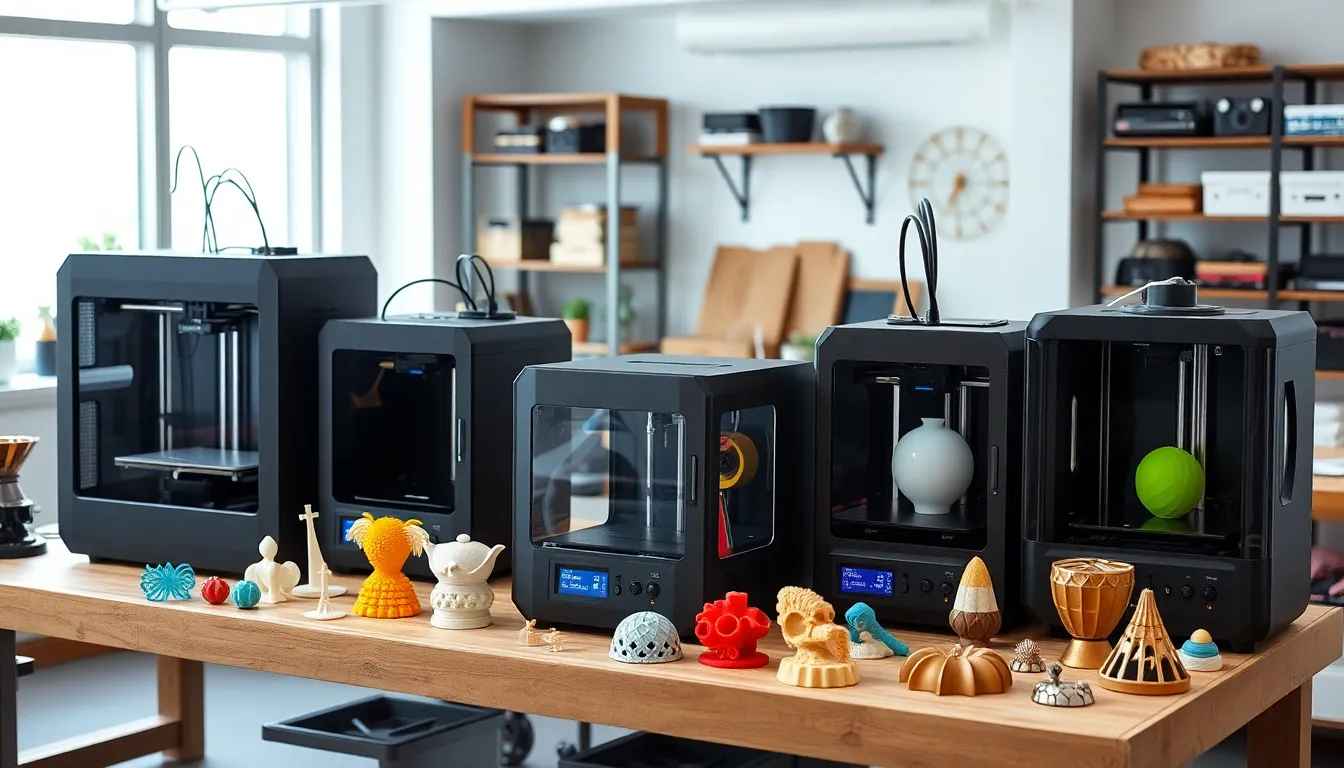
Various 3D printing technologies enable diverse applications, each with unique methods and materials.
Fused Deposition Modeling (FDM)
Fused Deposition Modeling, commonly called FDM, is one of the most popular 3D printing technologies. It extrudes thermoplastic filaments through a heated nozzle, layering materials to create objects. Designers favor FDM for its accessibility and affordability, making it ideal for rapid prototyping. Common materials like PLA and ABS are widely used in FDM, contributing to its versatility. Users note that FDM printers are easy to operate, even for beginners. Larger printers increase build sizes, allowing for bigger projects without significant cost increases.
Stereolithography (SLA)
Stereolithography, or SLA, utilizes a laser to cure liquid resin into solid objects. This technology excels in producing highly detailed and intricate designs. Designers often choose SLA for applications requiring fine precision, such as jewelry and dental molds. Rapid production is possible, which significantly reduces the workflow timeline. Various resin types allow customization for different properties, like flexibility or hardness. Users appreciate the smooth surface finish that SLA provides, enhancing aesthetics.
Selective Laser Sintering (SLS)
Selective Laser Sintering, known as SLS, uses a laser to fuse powdered materials into solid forms. SLS supports a wide range of materials, including plastics, metals, and ceramics. The process allows for complex geometries that traditional methods often struggle to produce. Designers often utilize SLS in industries such as aerospace and automotive for functional parts and prototypes. The lack of support structures in SLS printing streamlines the process, reducing post-processing time. Users find that the durability of SLS-printed parts rivals those made from conventional methods.
Applications of D Printing
3D printing serves various applications, showcasing its capabilities across multiple industries. Below are key areas where this technology excels.
Prototyping
Prototyping stands out as a primary application of 3D printing. Designers quickly create prototypes to test concepts and functionality. Fused Deposition Modeling (FDM), known for its affordability, facilitates rapid development. Iterations occur swiftly, allowing for adjustments based on feedback. This speed reduces time-to-market significantly, benefiting startups and established companies alike. Utilizing common materials ensures accessibility, making it easier to transition from digital design to tangible product.
Manufacturing
Manufacturing also benefits tremendously from 3D printing. Companies leverage Selective Laser Sintering (SLS) to produce complex parts with precision, optimizing resource use. Customization options are abundant, allowing manufacturers to tailor components for specific applications. Production runs can vary, accommodating both small batches and large quantities. This flexibility meets evolving demands in diverse fields, including aerospace and automotive. Shorter production timelines result in enhanced workflow efficiency, further underscoring the advantages of additive manufacturing.
Medical Uses
Medical uses of 3D printing revolutionize patient care and treatment. Customized implants and prosthetics are created to fit individual anatomical requirements. Stereolithography (SLA) allows for the precise crafting of surgical models, aiding in pre-operative planning. Additionally, bioprinting leads to advancements in tissue engineering, with ongoing research into printing living cells and organs. Such innovations hold potential for addressing organ shortages and improving transplant success rates. Enhanced accuracy and personalization reflect the significant impact of 3D printing in healthcare.
Benefits and Challenges of D Printing
3D printing offers numerous benefits and challenges that shape its use across various industries.
Advantages
Cost efficiency ranks high among the benefits of 3D printing. Businesses save money by reducing waste and lowering manufacturing costs. Speed also stands out as a key advantage. Designers produce prototypes quickly, accelerating the time-to-market for innovative products. Customization provides another significant benefit. Individuals can create tailored solutions for specific needs, enhancing user satisfaction. Additionally, versatility allows 3D printing to accommodate a wide range of materials, from plastics to metals. The technology fosters creativity, enabling artists and designers to explore new ideas, leading to innovative designs that push boundaries.
Limitations
Material limitations pose a challenge in 3D printing. Not all materials yield high strength or durability, affecting product reliability. Printing speed can also be a concern. While newer technologies improve speed, some methods remain slower than traditional manufacturing. Precision offers another challenge. Complex designs may require extensive post-processing to meet specific tolerances, adding time and labor to the process. Limited size capacity impacts larger projects, as many printers have size restrictions that can hinder production. Lastly, regulatory hurdles can complicate the integration of 3D printing in certain industries, particularly healthcare and aerospace.
Future Trends in D Printing
Advancements in 3D printing technology promise to reshape various industries. Speed improvements enhance production efficiency, allowing companies to meet market demands faster. Higher precision in printing ensures that intricate designs maintain their details. Multi-material printing emerges as a significant trend, enabling diverse material combinations within a single object.
Sustainability gains traction as environmental concerns increase. 3D printing typically generates less waste than conventional manufacturing. Estimates suggest material waste reductions of 30-60%. Researchers also explore biodegradable materials, aligning with eco-friendly practices.
Artificial intelligence integration plays a crucial role in optimizing printing processes. AI-driven systems will analyze data to enhance print quality and reduce errors. Predictive maintenance also improves equipment reliability, minimizing downtime.
Customization continues to rise in importance. Consumers increasingly seek personalized products tailored to their preferences. 3D printing easily accommodates this need, allowing for on-demand production. Industries like fashion and jewelry capitalize on this trend, offering unique designs.
Bioprinting stands at the forefront of medical innovations. Creating tissues and organs using 3D printing technology could revolutionize transplantation. Research into bioprinting living cells is ongoing, with significant implications for healthcare.
Education benefits from the expansion of 3D printing applications. Schools and universities incorporate this technology into curriculums, enhancing STEM education. Students engage in hands-on projects, developing skills that prepare them for future careers.
Manufacturers recognize the competitive advantages of adopting 3D printing. Cost efficiency, speed, and flexibility drive businesses toward this technology. Organizations that invest in 3D printing will likely gain a significant edge in the market landscape.
3D printing is reshaping how individuals and industries approach design and manufacturing. Its ability to create customized solutions quickly and cost-effectively opens new avenues for creativity and innovation. As advancements continue in speed precision and material diversity the technology’s impact will only grow.
The potential for 3D printing in sectors like healthcare aerospace and education highlights its versatility and importance. With ongoing research into sustainability and artificial intelligence integration the future of 3D printing promises even more exciting developments. Embracing this technology can lead to significant competitive advantages for businesses while also fostering a culture of creativity among users.